Lucía Andrea
Illanes Albornoz
🏳️⚧️ 𒊩 𒈨 𒊬𒊏 𒌓 𒁲𒆷 𒂊𒀀 🏳️⚧️
Notes concerning transdermal HRT
DISCLAIMER: The information provided on this page is offered as is for general educational purposes only. I am not a medical professional, and nothing here should be interpreted as medical advice, diagnosis, or treatment guidance. Endocrine care, hormone therapy, and any related decisions involve medical risk and should be discussed with a qualified healthcare provider. By using this information, you acknowledge that any actions you take are entirely your own responsibility, and you agree that I am not liable for any outcomes, consequences, or damages resulting from your use or interpretation of this material.[0]
Unless otherwise specified, the information provided on this page is based on the experience of the author of this document.
Interindividual variability applies; doubly so owing to General: familial pattern of hypophyseal dysregulation.
Table of contents
- Transdermal Oestradiol gel: 1.28g pumps vs. 1.25g
- Transdermal Oestradiol gel: use pump gently
- Transdermal Oestradiol gel: determining serum levels
- Transdermal Oestradiol gel: suboptimal concentration curve
- Transdermal Oestradiol gel: temporary discontinuation
- Transdermal Oestradiol gel: surface area
- Transdermal Oestradiol gel: steady state
- References
Transdermal Oestradiol gel: 1.28g pumps vs. 1.25g
An unnamed brand of transdermal Oestradiol gel is claimed by the manufacturer to produce 1.25g of gel upon pump activation.
This is not the case, as anyone with a digital scale may confirm for themselves. Instead, 1 pump corresponds to ~1.28g of
gel with fluctuation in the µg range. This must be taken into consideration when estimating how many pumps a single bottle
contains, after substracting the very first "priming" pump.
It is advised to integrate weighing the bottle after priming and after each pump with a suitable digital scale into one's
personal HRT protocol.
Transdermal Oestradiol gel: use pump gently
An unnamed brand of transdermal Oestradiol gel presents with an undocumented problem concerning its pump mechanism. If the
pump mechanism is engaged with excessive force as opposed to gently, it will, given 2 pumps p/d, predictably and reliably
break after about 21 days/3 weeks, at which point each pump will exceed 1.28g by a steadily increasing amount, as anyone with
a digital scale may confirm for themselves.
It is advised to integrate weighing the bottle after priming and after each pump with a suitable digital scale into one's
personal HRT protocol.
Transdermal Oestradiol gel: determining serum levels
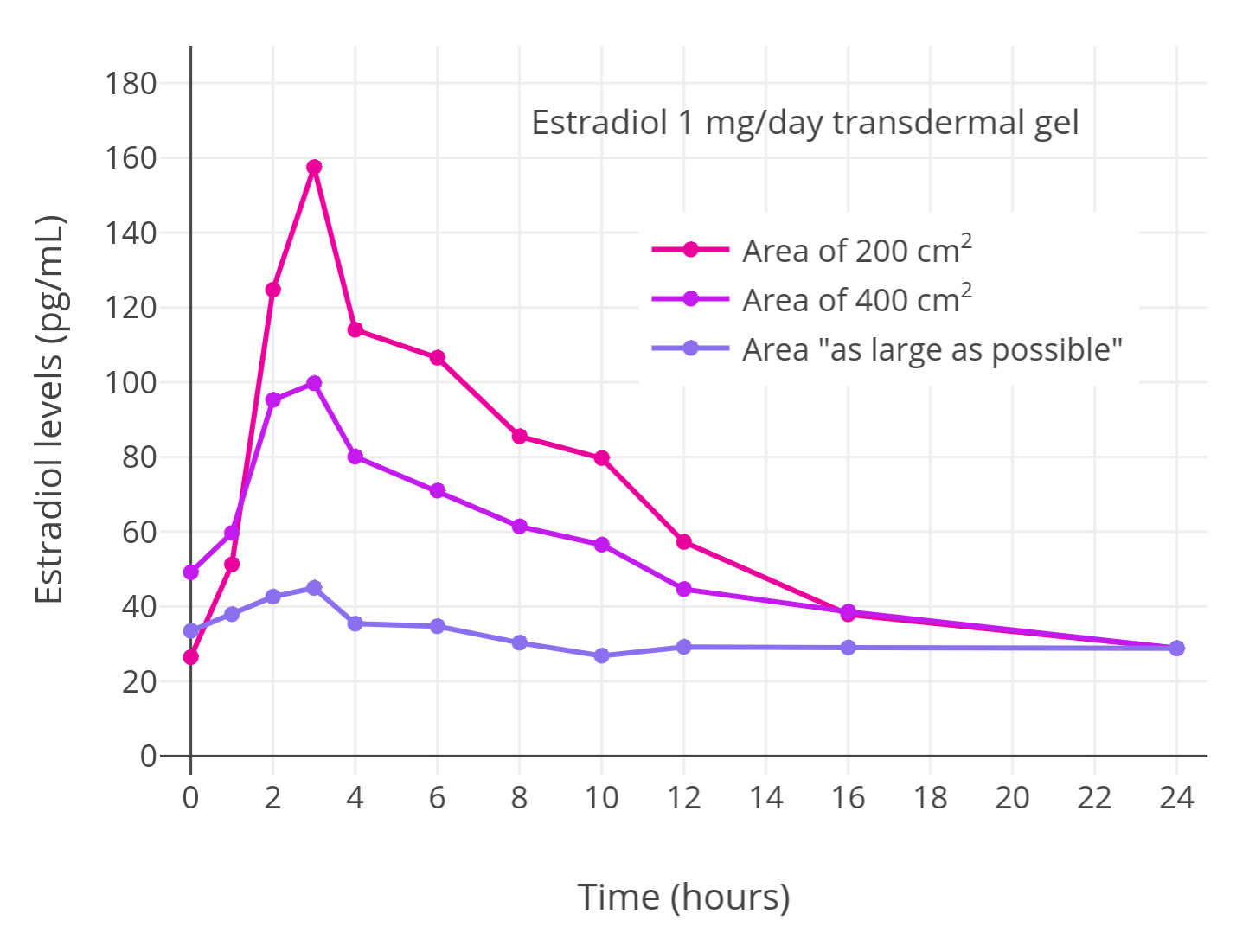
Estradiol levels after the last dose with 1 mg/day transdermal estradiol gel applied to different amounts of skin area (200 cm2, 400 cm2, or as large as possible) in postmenopausal women.[1]
As seen above, transdermal Oestradiol gel of whichever brand or manufacturer will generally present with a concentration curve across time as opposed to (ignoring brief peaks) stable levels, such as is the case with oral Oestradiol. This must be taken into consideration when attempting to determine serum levels as follows:
- Assay Cmax, e.g. the maximum or peak concentration at the 3 hour mark (Tmax.)
- Assay Cmin, e.g. the minimum or trough concentration at the 12 hour mark (Tmin,) e.g. right before the next dose.
-
Calculate Cmean, e.g. the average concentration, by, based on Cmax,
Tmax, Cmin, Tmin, finding the Area Under the Curve
(AUC,)[2] utilising the logarithmic method (((c1 - c2) /
(LN(c1) - LN(c2))) * (t2 - t1)) during the absorption phase (rising levels) and the linear method (1/2 * (c1
+ c2) * (t2 - t1)) during the elimination phase (falling levels.) This yields the maximum total exposure
during that time period which, when divided by that same time period, e.g. 24 hours, will yield the maximum
average concentration.
This is the most meaningful and important of the three pharmacokinetic parameters. Unless otherwise specified, any source specifying Oestradiol serum levels will refer to average concentration (Cmean.)
Transdermal Oestradiol gel: suboptimal concentration curve
Estradiol levels after the last dose with 1 mg/day transdermal estradiol gel applied to different amounts of skin area (200 cm2, 400 cm2, or as large as possible) in postmenopausal women.[1]
As seen above, transdermal Oestradiol gel of whichever brand or manufacturer will generally present with a concentration curve with a considerable peak-to-trough ratio and two peaks and two troughs p/d. It bears mentioning that this can be suboptimal for the same reason as with the concentration curve of Oestradiol Valerate.
Transdermal Oestradiol gel: temporary discontinuation
When discontinuing, wait for between four to five weeks, taking cycle boundaries into account, before resuming and be mindful
of both severely hypogonadic menopausal Oestradiol levels as well as, given insufficient Testosterone suppression, gradually
rising Testosterone levels, though SHBG being slow to respond is helpful here, and, eventually, well into the 2nd month,
hypothyroidism; being as there is no reservoir effect with transdermal Oestradiol gel, any Oestradiol remaining at trough,
irrespective of time to steady state, will be gone within an hour at most, at which point endocrine Oestradiol will be strictly
adrenal on the input side.
With regard to the time period required to wait for: two weeks (11.5 days): crashes after day 17.5), three weeks (18.5 days):
crashes after week #5, at least four weeks (32 days): stable after one cycle, according to experimental evidence. It would appear
probable that this is both a function of SHBG stability (steady state after max. 5 weeks) as well as compound ER state, e.g.
ER population (density) in each cell as well as sensitivity and all factors relating to ER housekeeping from transcription/translation to
activation and elimination and all factors significantly affected by (effective) Oestradiol.
Furthermore, the presumed Oestradiol-driven ER density/sensitivity oscillations (cycles) appear to be only loosely coupled to
their Oestradiol inputs and present with a considerable degree of hysteresis, e.g. they will maintain their internal state even
if the external signal in its original state is absent for an unknown time period that may or may not correspond to between
four-five weeks and may indeed be much longer, with the possibility of cycles gradually becoming more and more protracted, as
observed in menopause and the phenomenon of cycles persisting after a hysterectomy.
For a general overview that does not specifically focus on ERs, refer to [3].
Transdermal Oestradiol gel: surface area
Estradiol levels after the last dose with 1 mg/day transdermal estradiol gel applied to different amounts of skin area (200 cm2, 400 cm2, or as large as possible) in postmenopausal women.[1]
Always use the smallest possible surface area when applying transdermal Oestradiol gel in order to maximise absorption.
Transdermal Oestradiol gel: steady state
The documented maximum time to steady state parameter of transdermal Oestradiol gel of three days is incorrect. Oestradiol, acting as a transcription factor, significantly induces CYP3A4, effectively increasing clearance/elimination relative to a masculine phenotype. Given a half life of between 1-6 days, this process should take no more than about two weeks to complete at most, before which, however, steady state is not achieved.
References
[0] (courtesy of ChatGPT)[1] This work is licenced under the CC BY-SA 4.0 licence, courtesy of Medgirl131, retrieved at Fri, 12 Jun 2026 10:26:07 +0200, linked to in Pharmacokinetics of estradiol - Wikipedia.
[2] Principles of Pharmacokinetics - Holland-Frei Cancer Medicine - NCBI Bookshelf
Area under the curve (pharmacokinetics)
[3] Melvin E. Andersen and Hugh A. Barton - Biological Regulation of Receptor-Hormone Complex Concentrations in Relation to Dose-Response Assessments for Endocrine-Active Compounds
© 2017, 2018, 2019, 2021, 2022, 2023, 2024, 2025, 2026 Lucía Andrea Illanes Albornoz | email: lucia@luciaillanes.de
CC BY 2.0 background photography Sevilla-4-9 courtesy of ajay_suresh on Flickr
Created with Vim, hosted by OVH & Hurricane Electric DNS, served by nginx & PHP on Ubuntu.